


What Is a Subnet in Cryptocurrency?
What Is a Subnet in Cryptocurrency?
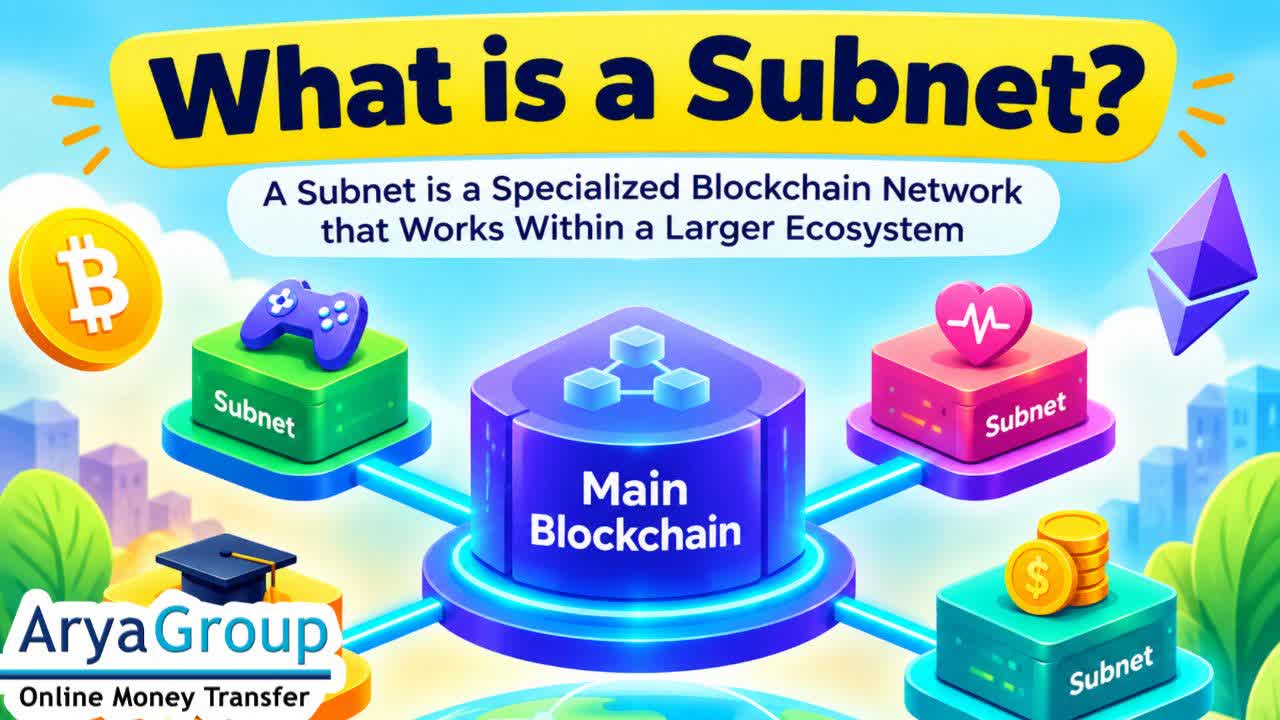
A subnet in cryptocurrency is a smaller, specialized blockchain network that operates within or alongside a larger blockchain ecosystem. The main idea is to give developers more flexibility instead of forcing every application to use exactly the same rules, resources, and transaction environment.
One of the best-known examples is the Avalanche ecosystem, where Subnets were designed to allow groups of validators to support their own blockchain environments. In simple terms, a subnet can be thought of as a dedicated blockchain space built for a particular application, project, or use case.
Important: Subnet is not necessarily the name of a cryptocurrency or a coin. It is primarily a term for a blockchain network structure.
How Does a Subnet Work?
A subnet brings together a group of validators that are responsible for checking transactions and maintaining a particular blockchain. This structure allows the network to separate different applications from one another.
For example, imagine a large shopping center with separate stores. Instead of every store sharing exactly the same space and rules, each store has its own area while remaining part of the larger complex. A subnet works in a somewhat similar way.
In Avalanche's original architecture, Subnets were validated by a subset of Primary Network validators. Avalanche's newer architecture increasingly uses the term Avalanche L1 for newly created sovereign networks, while the older Subnet terminology remains in the technology and documentation.
Why Were Subnets Created?
Traditional blockchains often have to serve many different applications at the same time. When network activity becomes high, this can create congestion and increase transaction costs.
Subnets offer a way to create more dedicated blockchain environments. Developers can design a network around the needs of a specific project rather than relying entirely on a single shared blockchain.
According to Avalanche documentation, separate blockchain environments can provide resource isolation, meaning activity on one chain does not necessarily have to consume the same resources as another chain.
What Can a Subnet Be Used For?
Subnets can be designed for different purposes, including:
- Decentralized applications
- Gaming platforms
- Financial applications
- Enterprise blockchain systems
- Digital assets and NFTs
- Networks that require customized transaction rules
- Applications that need their own fee structure
The exact design depends on the blockchain architecture and the choices made by its developers.
Does a Subnet Have Its Own Cryptocurrency?
A subnet can have its own economic system, including a native token or customized fee structure, depending on how the network is designed. This is one reason subnets can be attractive to developers who want more control over their blockchain environment.
However, it is important to distinguish between a subnet and its native cryptocurrency. The subnet is the network structure, while the token is an asset that may be used within that network.
What Are the Advantages of Subnets?
One major advantage is customization. Developers can create blockchain environments with rules and technical settings suited to their applications.
Another benefit is scalability. Instead of placing every application on one blockchain, different applications can operate on separate networks.
Subnets can also provide greater control over validators, transaction processing, fees, and other network parameters, depending on the underlying design. Avalanche's documentation shows that subnet and chain configurations can be customized for different technical requirements.
What Are the Challenges of Subnets?
Subnets are not a solution to every blockchain problem. Running a separate network can introduce additional technical and economic complexity.
A project may need to attract and maintain a reliable group of validators. It also has to consider security, liquidity, user adoption, interoperability, and maintenance.
Another challenge is that creating a specialized blockchain does not automatically guarantee that people will use it. A technically strong subnet still needs developers, users, applications, and a useful ecosystem.
Subnet vs. Main Blockchain
The easiest way to understand the difference is to think about specialization versus generalization.
A main blockchain generally provides a shared environment for many applications. A subnet creates a more specialized environment that can be designed around particular requirements.
This separation can help applications avoid competing directly for the same blockspace. At the same time, it means that developers have more responsibilities when managing their own network.
The Future of Subnets
The concept of subnets has become an important part of blockchain infrastructure because the industry is moving toward increasingly modular and application-specific networks.
Avalanche has also evolved its architecture from the original Subnet model toward Avalanche L1s, which are designed to offer greater independence and flexibility. Current Avalanche documentation recommends new blockchain projects consider L1s while continuing to support the older Subnet architecture.
Final Thoughts
In simple terms, a subnet is a specialized blockchain environment connected to a larger ecosystem. It allows developers to create networks that can have their own rules, validators, applications, and economic structures.
The concept is especially important for understanding how blockchain networks can move beyond the idea of one giant chain handling every application. Instead, multiple specialized networks can work as parts of a broader ecosystem.
Add New Comment